
© Maggie Kilbey 2026












Holy Trinity, Norton-juxta-Twycross (Leicestershire)

Barrel Organs in English Parish Churches
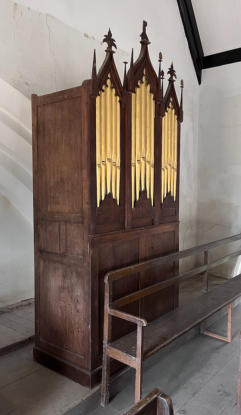
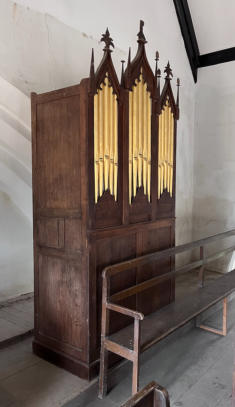
1819 barrel organ by James Butler of London (d.1863). Installed when the church was restored in 1841. Probably given by Richard Curzon-Howe
(Earl Howe) of Gopsall Hall, Norton-juxta-Twycross.
The organ is located in the west gallery, only accessible from the tower. Operated from the rear and blown by the crank handle, therefore it is
impossible to dwell on the chanting notes on barrels 2 & 3 without losing wind pressure. The oak Gothic case has three flats of gilt dummy
pipes (5-5-5) backed with cream cloth.
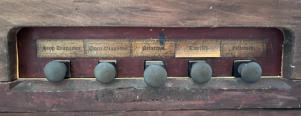
Stop list: Stop Diapason 8’, Open Diapason 8’, Principal 4’, Twelfth 2 2/3’, Fifteenth 2’
Restored from a derelict condition in 1980-1 by F.W. Burns & Son of Nuneaton. The majority of the 92 metal pipes were missing, but replaced
with pipes of a similar age and revoiced to, as near as possible, the tone of the originals. All but six of the wooden Stop Diapason pipes are
original. Cleaned, but not restored, and a top put on in 2015 by Bishop & Sons following roof and ceiling repairs. Tunes recorded in 2026.
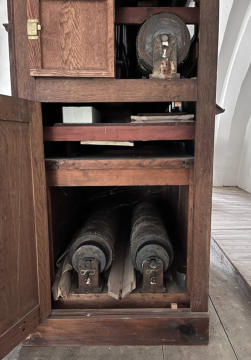
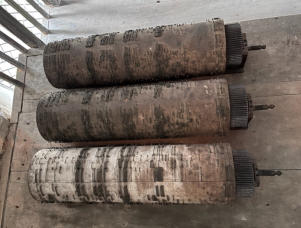
Three carriage-mounted painted barrels x 10 tunes. Evidence of repinning on barrels 1 & 2. Several notes do not sound for many of the tunes,
particularly on barrel 2, and in several areas adjacent bridges have been soldered together. Barrel three is pinned with chants and has seen
little use (see comment above).
Photos: M. Kilbey.
References: Burns restoration notes on organ case; Leicester Journal (26 Nov. 1841) 3; Boston (1959); Boston & Langwill (1967);
Hinckley Times (24 Jun. 1993) 15.



BARREL 1
BROWN
Tune
Metre
1.7
[damaged]
BARREL 2
BROWN
Tune
Metre

© Maggie Kilbey 2026
Barrel Organs in English Parish Churches


Holy Trinity, Norton-juxta-Twycross
(Leicestershire)
1819 barrel organ by James
Butler of London (d.1863).
Installed when the church was
restored in 1841. Probably given
by Richard Curzon-Howe (Earl
Howe) of Gopsall Hall, Norton-
juxta-Twycross.
The organ is located in the west
gallery, only accessible from the
tower. Operated from the rear
and blown by the crank handle,
therefore it is impossible to
dwell on the chanting notes on
barrels 2 & 3 without losing wind
pressure. The oak Gothic case
has three flats of gilt dummy
pipes (5-5-5) backed with cream cloth.
Stop list: Stop Diapason 8’, Open Diapason 8’, Principal 4’, Twelfth 2
2/3’, Fifteenth 2’
Restored from a derelict condition in 1980-1 by F.W. Burns & Son of
Nuneaton. The majority of the 92 metal pipes were missing, but
replaced with pipes of a similar age and revoiced to, as near as
possible, the tone of the originals. All but six of the wooden Stop
Diapason pipes are original. Cleaned, but not restored, and a top put
on in 2015 by Bishop & Sons following roof and ceiling repairs. Tunes
recorded in 2026.
Three carriage-mounted painted barrels x 10 tunes. Evidence of
repinning on barrels 1 & 2. Several notes do not sound for many of
the tunes, particularly on barrel 2, and in several areas adjacent
bridges have been soldered together. Barrel three is pinned with
chants and has seen little use (see comment above).
Photo: M. Kilbey.
References: Burns restoration notes on organ case; Leicester
Journal (26 Nov. 1841) 3; Boston (1959); Boston & Langwill
(1967); Hinckley Times (24 Jun. 1993) 15.

BARREL 1
BROWN
Tune
Metre
1.7
[damaged]
BARREL 2
BROWN
Tune
Metre